From Pharaohs to Pixels: How Hassan Ibrahim is Teaching Machines to Talk to Us
 Nadeen Sami
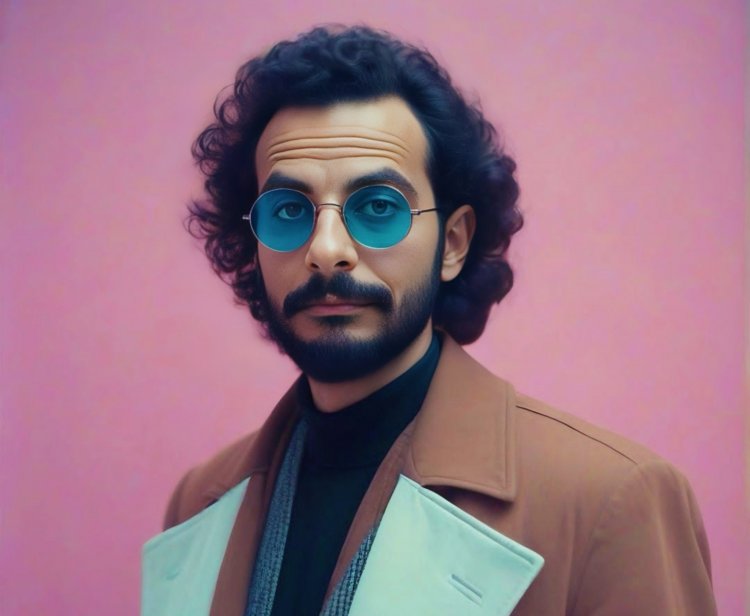
In the ever-evolving landscape of artificial intelligence, there are those who simply observe its potential, and then there are visionaries like Hassan Ibrahim, a name synonymous with innovation and ingenuity in the field. At just 31 years old, Hassan stands as a testament to the transformative power of dedication and intellect. After graduating from Menoufia University's Faculty of Science, he embarked on a journey that would see him not only delve deep into the realms of AI but also emerge as a trailblazer, wielding algorithms and neural networks to carve a path toward a future where machines not only assist but astound. With seven years of relentless pursuit, Hassan has honed his craft, navigating through the complexities of artificial intelligence to craft solutions that redefine the boundaries of possibility. Today, his name is etched not just in the annals of academia, but in the algorithms that power groundbreaking advancements, leaving an indelible mark on the world of AI and beyond.
That's both daring and dazzling, harnessing the power of algorithms and neural networks to propel us into an era where the impossible becomes routine. With each keystroke, Hassan's brilliance blurs the line between science fiction and reality, crafting solutions that not only solve problems but spark revolutions. Today, his legacy isn't just written in code; it's etched in the very fabric of our technological landscape, a testament to the boundless potential of the human mind and the machines it creates.
Our recent encounter with Hassan Ibrahim wasn't just an interview, it was a glimpse into the future. This man, who has spent the past seven years etching his name into the annals of AI engineering, exudes a passion as contagious as the algorithms he crafts. It wasn't simply his groundbreaking work in AI advertising that captivated us, but the depth of his vision for the field's potential to reshape the very fabric of human interaction. Consider it a privilege to have delved into Hassan's world, a world where machines learn to speak our language, and advertising transcends mere marketing to become a conversation between technology and the human experience.
Gear up for an exciting journey with Hassan..
Hello Hassan, can you tell us about your journey into AI engineering, and what specifically drew you to focus on the advertising field?
I have been working in the field of artificial intelligence for 7 years now. I wanted to study computer science, but I joined the faculty of science so I entered the Department of Pure Mathematical Sciences and Computer Science, and by chance this turned out to be the most suitable department to specialize in artificial intelligence at the moment because it needs to be good at both math and programming.
How did you start your career?
I started working in the field of artificial intelligence after I graduated from the Faculty of Science, Department of Pure Mathematics and Computer Science, from Menoufia University. There are many online courses on statistics and programming, and my first job was at MO4 Network as an AI Developer Chatbot, where I was able to use learning and statistical modelling techniques. I then worked at Snappers Systems as an AI Computer Vision Engineer, focusing on developing algorithms to analyze real motion to transform 3D faces in real-time. Now, I work in Netherlands at Reblium Company as an AI Engineer, and I develop complex systems in the field of visual computers.
What was your first job? Do you experience any difference in your current job?
My first job was at MO4 Network as an AI Developer Chatbot. I was working on developing and evaluating algorithms to improve performance, quality, and accuracy in data analysis. This job was a very good opportunity to apply what I learned in college and learn new things in the field of artificial intelligence.
Now, after 7 years, I feel a big difference in my work. I gained extensive experience and developed my skills greatly, and I continued to work on more complex projects. I worked in advertisements and films, the work of which was difficult in Egypt, such as Tamer Hosni’s advertisement. It was the first advertisement that included artificial intelligence. Then I entered films and then in entertainment in general in Egypt and other countries.

What are the biggest challenges you face in developing advertising solutions powered by artificial intelligence?
The biggest challenges faced in developing advertising solutions powered by artificial intelligence include:
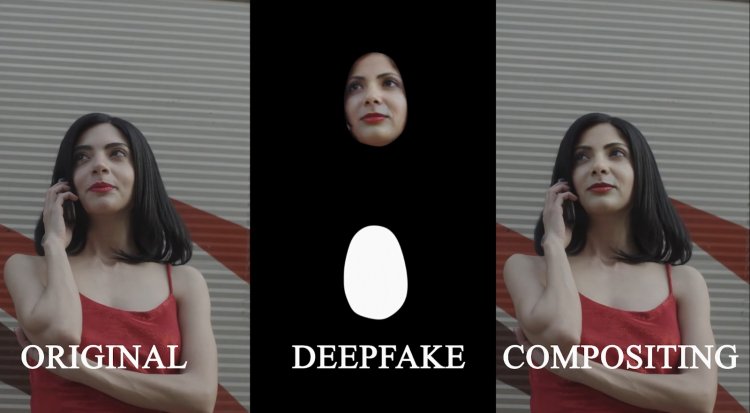
Quality and accuracy: Maintaining high quality and accuracy in the results, especially in techniques such as deepfake, is very important for ads to be convincing and safe.
Ethics: Addressing ethical and privacy concerns in using AI to generate realistic content.
Technology Integration: Ensuring new technology integrates with existing systems without problems.
Personalization and interaction: Developing tools to interact with the audience and suit their needs.
There are some concerns about AI potentially manipulating consumers. How do you ensure ethical practices in your work?
To ensure ethical practices in our work, we focus on basic needs:
Transparency: We make it clear to consumers that the technology used in advertising is artificial intelligence.
Consent: We ensure clear consent from the people used in our ads, especially in techniques such as deepfake.
Control: We give consumers complete control over their data and explain to them how we use it.
Review: We periodically review technology and advertisements to ensure they adhere to ethical standards.
Looking ahead, what exciting possibilities do you see for AI in the future of advertising?
Honestly, the future of AI in advertising is full of exciting possibilities:
Hyper-Personalization: The ability to deliver ads that are hyper-personalized to each individual based on their preferences and behavior.
Interactive Experiences: Using artificial intelligence to create interactive experiences such as augmented reality (AR) and virtual reality (VR) ads.
Advanced Analytics: Analyze data more accurately to anticipate market trends and adjust advertising strategies in real-time.
AI-Generated Content: Using artificial intelligence to produce creative content such as videos and graphics.
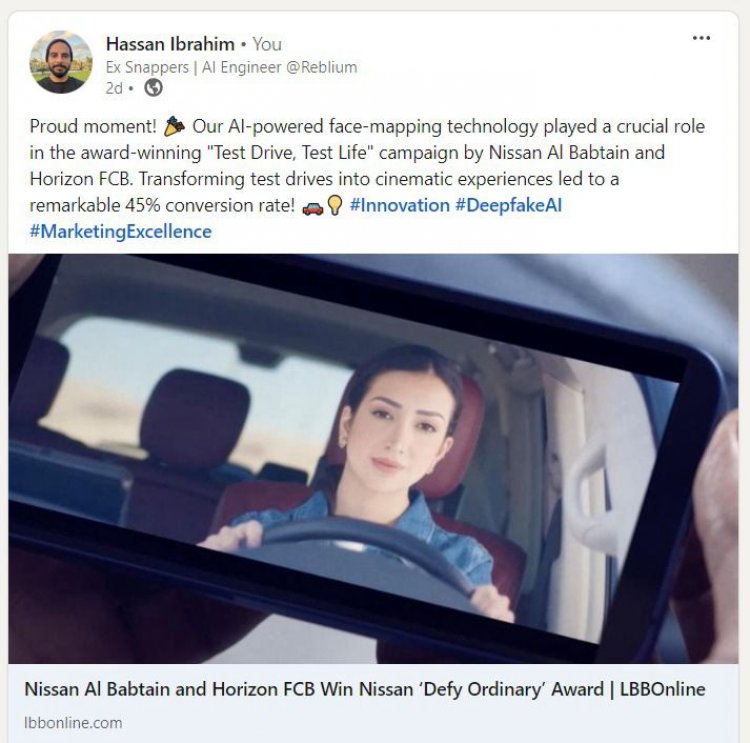
Undoubtedly, Hassan’s hard work has paid off. Reflecting the nature of his impressive accomplishments, he hit the jackpot with his recent "Defy Ordinary" Award.